
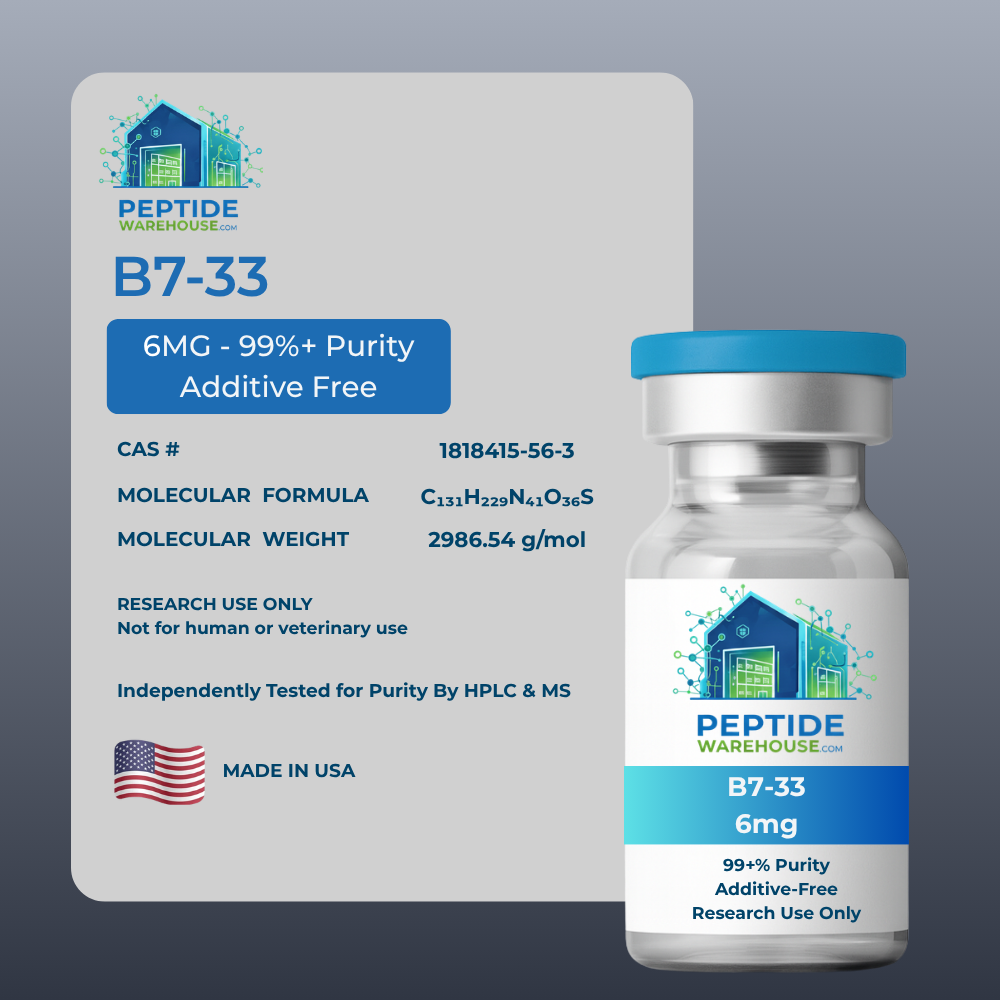
B7-33
$59.99
B7-33 – Research-Grade Single-Chain Relaxin Analog Peptide
B7-33 is a synthetic 26-amino-acid single-chain peptide derived from the B-chain of human relaxin-2, retaining the receptor-interaction residues of the parent hormone while omitting the A-chain and the disulfide architecture that define the native two-chain molecule. This simplified single-chain design separates B7-33 structurally from full-length relaxin and from other fibrosis-associated research peptides, and in laboratory research settings it is utilized as a reference material for studying RXFP1 receptor-binding models, biased signaling pathway selectivity, and structure–activity relationships within the relaxin peptide class. Owing to its truncated sequence and absence of interchain disulfide bonding, B7-33 exhibits physicochemical properties that allow researchers to examine peptide stability, folding-independent receptor engagement, and putative regulatory activity in vitro without reliance on the more synthetically demanding native heterodimer.
Its reproducible synthetic profile supports controlled use in mechanistic assays, comparative analog studies against full-length relaxin constructs, and exploratory biochemical research conducted under controlled laboratory conditions. This material is intended strictly for laboratory research use only and is not designed for human or veterinary application.
Related research compounds
BPC-157 · TB-500 · ARA-290 · LL-37 · VIP · KPV
Documentation and methods
Analytical testing · How to read a COA · Batch COAs · Storage and handling · What are research peptides
Related products
New Peptides
New Peptides
New Peptides
New Peptides